hopeful monsters Hopeful Monsters – Dalkey Archive Press
SKU: 42324045625
hopeful monsters

hopeful monsters Hopeful Monsters – Dalkey Archive Press

Sale price$25.25 Regular price$28.05
Save 10%

Pay in installments of $7.01 with ShopPay, AfterPay and Klarna

Shipping Estimate
USA
  • USA
  • CAN

Ships within 48 hours · Estimated delivery Jul 6 - Jul 11

Promo Codes Available:

For Your Every Summer RSVP, with Code: SUMMER15

Description

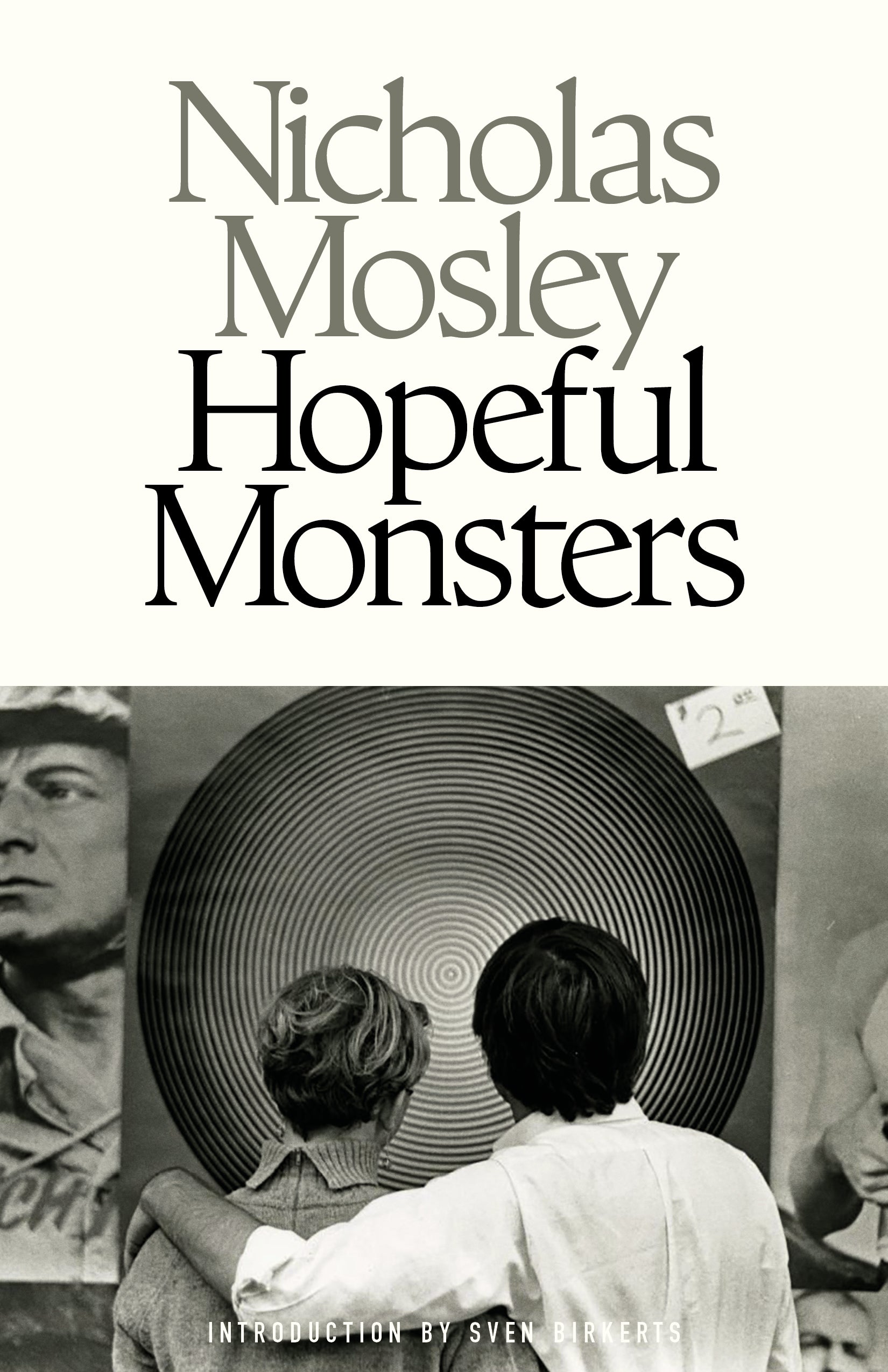
hopeful monsters Hopeful Monsters – Dalkey Archive PressBy Nicholas Mosley Introduction by Sven Birkerts ISBN: 9781628975741 Publication Date: 3 10 2026 Thirty five years after its original publication, Hopeful Monsters reemerges as one of the grand intellectual dramas of the 20th century (The New York Times). A sweeping, comprehensive epic, Hopeful Monsters tells the story of the love affair between Max, an English student studying physics and biology, and Eleanor, a German Jew and political radical.

By Nicholas Mosley
Introduction by Sven Birkerts

ISBN: 9781628975741

Publication Date: 3/10/2026

Thirty-five years after its original publication, Hopeful Monsters reemerges as one of the “grand intellectual dramas” of the 20th century (—The New York Times).

A sweeping, comprehensive epic, Hopeful Monsters tells the story of the love affair between Max, an English student studying physics and biology, and Eleanor, a German Jew and political radical. Together, Max and Eleanor participate in the great political and intellectual movements which shape the twentieth-century, taking them from Cambridge and Berlin to the Spanish Civil War, Russia, the Sahara, and finally to Los Alamos to witness the first nuclear test.

Originally published as the culminating volume of a series of five works of fiction entitled “Catastrophe Practice” that The Chicago Tribune called “one of the most important extended literary projects of [the 20th] century,” Hopeful Monsters is the first reissue in a new Dalkey Archive initiative to bring Mosley’s epistolary genius back into circulation for modern readers.

"The two things that are extremely impressive about this book are, first, its intellectual energy and rigour and, secondly, Mosley's gift, rivalling Koestler's or Bertrand Russell's, for summarising extremely difficult ideas in an easily intelligible manner." Spectator

"This is a major novel. I read it barely stopping to eat and sleep. It is the sort of book that one reads again and again, making new discoveries at each reading." Hampstead & Highgate Express

"Fascinating. . . . The novel achieves grand intellectual drama." —Christopher Lehmann-Haupt, New York Times

"The most ambitious English novel written in the past 50 years ... an amazing achievement." Washington Post Book World

"The culminating volume of a series of five fictions called 'Catastrophe Practice' that may be one of the most important extended literary projects of this century . . . Mosley has been feeling his way toward what is ultimately a hopeful vision of the human prospect after having comprehended—in virtually every sense of the term— the turbulence and torments resulting from this century's fierce intellectual and ideological conflicts." —Chicago Tribune

"A brilliant literary performance." —Forward

"What makes Hopeful Monsters a successful book is not so much its big ideas but the passionate intelligence through which they're refracted." —San Francisco Chronicle

"A rich panorama of 20th-century politics and ideas and an affecting love story, the novel combines the epic sweep and narrative drive of popular fiction and the intellectual authority of the best of Milan Kundera or Saul Bellow." —Newsday

"Intellectual and emotional history become delicately and provocatively joined in an agile narrative of the wages of hope in a monstrous century. . . . One of the grandest novels of ideas of our time." —Voice Literary Supplement

"Hopeful Monsters's success lies in Mosley's skill at personalizing sweeping historical events and complex theories ... an extraordinary novel." Boston Globe

"There is, as always in Nicholas Mosley's writing, the pleasure of eloquent ideas eagerly and warmly shared." —Washington Times

Nicholas Mosley (b. 1923) was raised in London, England. He is the author of a dozen novels and a half-dozen works of non-fiction, including an acclaimed biography of his father, the late Sir Oswald Mosley, leader of the fascist party in England in the 1930s. Films have been made of two of his novels, Accident (using a screenplay by Harold Pinter and directed by Joseph Losey) and Impossible Object. Mosley passed away in London in 2017 at the age of 93.

Sven Birkerts is the author of 12 books of essays and memoir, most recently The Miro Worm and The Mysteries of Writing. Former Director of the Bennington Writing Seminars, he co-edits the journal AGNI. He lives in Amherst, Massachusetts with his wife.

Shipping Notes
  • Free Standard Shipping on $100+ Orders to the USA.
  • Except Preorder products are shipped in 48 hours.
  • Delivery to the USA:
  1. Standard Shipping : 3-10 business days
  • If time is of the essence, please consider selecting expedited delivery for faster service.
Exchange/Return Notes
  • We offer a 30-day return/exchange service after receiving.
  • Final sale items are not eligible for returns or exchanges.
  • To process your return/exchange, please contact us at [email protected]
  • Please click here for more details>>> Return & Exchange Policy
SKU: 42324045625

Discover Niche Categories That Outsell hopeful monsters

Top-Converting Item to Boost Your Average Order

4.8 ★★★★★
Based on 2490 reviews
Sort
Highest Rating
Newest First
Oldest First
Product Reviews
L
Verified Purchase
L.m
Draper, US
★★★★★ 5
Get it!! You won't regret it
I don't know what to say but if you are considering buying this,do so... I've been using it a little bit over a week and to be honest I have used all kinds of makeup and lotions and I was never impressed even with experience brands, This stuff I'm already noticing a difference in wrinkles and it's so soothing. Just buy it and try it for yourself, I'll definitely be buying more
WAS THIS REVIEW HELPFUL?YesReportShare
Reviewed in the United States on August 27, 2025
M
Verified Purchase
MB
Carnegie, US
★★★★★ 5
Hydrating
New fav. My teenager loves it
WAS THIS REVIEW HELPFUL?YesReportShare
Reviewed in the United States on January 10, 2026
R
Verified Purchase
Ruth
Lexington, US
★★★★★ 3
It’s okay
I use it for a month. I saw no difference. It does give you a glow for a few minutes and it does hydrate. No scent and it didn’t break me out.
WAS THIS REVIEW HELPFUL?YesReportShare
Reviewed in the United States on March 19, 2026
L
Verified Purchase
Lana
Boise, US
★★★★★ 5
Good
Good
WAS THIS REVIEW HELPFUL?YesReportShare
Reviewed in the United States on January 22, 2026
D
Verified Purchase
dra
Cuba, US
★★★★★ 5
Fractured pop art masterpiece
Walker (Lee Marvin) and Mal Reese (John Vernon) stage a robbery, stealing a bag of cash from some crooks conducting a delivery by helicopter in deserted Alcatraz. Reese double crosses Walker and leaves him for dead, taking off with the cash and Walker's wife. Walker survives, escapes from the island, and comes after Reese, and all the rest of his criminal organisation, with the mantra, "I want my $93,000." On this third or fourth viewing, I was struck less by what an exemplary action film this is (Marvin, the hardest man in the history of the movies, was at least as mean and relentless in The Killers), and more by how deeply artiness is infused into its structure and design. The recurrent flashing back and forward in time, especially at the start between the planning - not in the traditional meticulous heist film set up, just a series of fractured, barely linked brief meetings and conversations - and the robbery, but also Walker's thoughts returning to his betrayal, feed the predominant critical interpretation that Walker was fatally wounded on Alcatraz, and the whole film is his trying to process this and his fantasy of revenge. Boorman addresses this directly in the commentary, to the extent that he refuses to commit and says it's intended to be ambiguous. I'm now firmly in the dying-flashback camp, because of Walker's almost magical powers. (On reflection, it's like the question of whether Deckard is a replicant - you can enjoy debating it and looking for clues, but in the end the answer is yes.) He appears in new scenes and locations with no evidence of having travelled, and generally in a spiffy new outfit (more of this later) despite carrying nothing but his revolver, and, particularly in the central sequence, he evades being apprehended either by coincidence (the lift he's in opens and closes while the baddies waiting for the same lift are distracted by a commotion) or by the sheer application of cool (waiting immobile but scarcely invisible in an underground car park while his pursuer is gunned down by police). He also has an advisor/mentor, played by Keenan Wynn, who pops up in scenes like a cartoon character (he looks like a sort of dome shaped, bristle headed man in a suit who might appear in Ren and Stimpy) and gives Walker his next mission, while the two of them assiduously avoid eye contact as if one or both aren't really there. From Walker's re-emergence in the first of a series of natty suits, Point Blank is constructed as a series of set pieces. The first is the oddest, continuing the flashbacks and playing with chronology. Walker is seen striding intently down a corridor, and we hear the sound of his footsteps over a series of scenes of his meeting his wife, and the two of them sharing innocent good times with Reese. He confronts his wife, fires six shots into her bed before realising Reese isn't there. A scene later, she's dead after an apparent overdose. A scene after that, the body is gone, the apartment is bare, and Walker has boarded himself inside. Did Walker even see his wife? Had she died already? A messenger arrives from whom Walker extracts a name, and he's off chasing the next link. Walker meets care dealer Big John, whose yard has enormous signs in a jazzy '50s font. He asks for a test drive, buckles his seatbelt, and smashes the car between pillars (c.f. The Driver) until John spills the next name. The most self-consciously art-directed scene follows, in which Walker visits a nightclub which features both a bikini-clad go-go dancer and a trio playing something between jazz and James Brown. Tipped off by a flirtatious waitress that he's being followed, he ducks behind the stage, and fights two baddies while giant faces are projected on a huge screen behind him. In a moment that suggests Tarantino watched this while writing Inglourious Basterds, Walker pulls down a rack of celluloid canisters to trap one pursuer, and then returns things to some kind of action movie orthodoxy by subduing the other one with a haymaker to the groin. In the centrepiece, Walker meets his sister-in-law Chris (Angie Dickinson). Grief and his mission of revenge don't mean he misses the chance to share her bed, and emerge, manhood serenely unthreatened, in her borrowed yellow shortie robe. The colour scheme gets turned up to 11 at this stage, with Walker in a mustard shirt-sports jacket combo (his outfits get truly creative whenever he's bedded Angie - later, he sports a shirt somewhere between salmon and ruby grapefruit - which I guess is the wardrobe equivalent of Joseph Gordon Levitt's post-coital dance routine in (500) Days of Summer), Angie in a rockin' yellow shift dress and matching '60s mid-length coat (let down soon after by wearing something striped like a bee), and Reese in a light tan, crushed velour t-shirt that might be the least flattering male garment in cinema until Borat's mankini. Walker even finds a sightseeing telescope painted lemon yellow, which he casually dislocates from its moorings to scope out Reese's penthouse lair. Once Reese is dealt with, the movie shifts into an early example of crime-as-big-business. Reese's boss is Carter, whose sleek Mad Men-style office and threads are matched by his resemblance to that series' Ted. According to IMDb, Lloyd Bochner, who plays Carter, was doing voice-over work from age eleven, and between him, Vernon's baritone (you know how it sounds - like Dean Wormer: "Fat, drunk and stupid is no way to go through life, son."), and Marvin's basso profundo, there's a meeting of male voices unmatched until, say, Brideshead Revisited. Around this point the architecture of LA attracts more and more focus, both modernist glass towers and the concrete culvert of the LA River, where a sniper lurks who might have inspired the climactic shooter in Get Carter. The commentary is conducted as a dialogue between Boorman and Soderbergh, who, if you've seen this, early Nic Roeg (Performance and Don't Look Now), and were already acquainted with the colour yellow, seems less original than he otherwise might. He has the decency to open by talking about how many times he's stolen from Point Blank. He's not the only one though. Point Blank deconstructs and toys with the action film as knowingly as anything in the 45+ years since, up to and including Archer and the entire oeuvre of Shane Black. Just when it's in danger of becoming too clever to be satisfying as a genre piece, it gets your attention with a pistol whipping, a punch to the groin, or the rarely-shown actual end result of the villain-takes-a-long-fall thing. And of course there's Marvin, who, whether dressed like a dandy, wearing a robe, or looking baffled when the next corporate criminal explains that they just don't have $93,000 to hand over, can't be beat. Seriously, you're not obliged to love it, but you have to see it at least once.
WAS THIS REVIEW HELPFUL?YesReportShare
Reviewed in the United States on May 3, 2014

recommand products